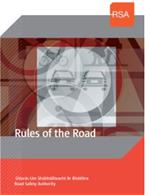
Trying to find the latest RSA Driving Test Questions? National Driving School has got you covered! When you take your driving test, the tester may ask questions related to the Rules of the Road, road signs and general driving knowledge.
We have compiled a set of commonly asked driving test questions to help you brush up on your knowledge and understand the type of questions you may be asked. If your test is coming up soon, you can also prepare with our Pre-Test Driving Lessons.
Get Prices 085 118 1111
Download Driving Test Questions PDF
63 Driving Test Questions
Click on each question to reveal the answer and test your knowledge before your driving test.
The questions below cover Rules of the Road, road signs, hand signals, vehicle safety, under-the-bonnet checks, car controls and general driving knowledge.
1. Rules of the Road & Driving Situations
1. Who has priority at a roundabout?
You must give right of way to traffic already on a roundabout.
2. When can you overtake on the left?
- When you want to go straight ahead & the driver in front of you has moved out & signalled that they intend to turn right.
- When you have signalled that you intend to turn left.
- When traffic in both lanes is moving slowly & traffic in the left-hand lane is moving more quickly than the traffic in the right-hand lane.
3. Where should you not overtake?
Near a bend, the brow of a hill, a hump back bridge, a continuous white line, where your vehicle would obstruct a sign, at an entrance, opposite another vehicle on a narrow road, a taxi rank.
4. When being overtaken, what must you not do?
Increase your speed.
5. Who has priority at an unmarked crossroads with roads of equal importance?
Give priority to traffic on the junction & traffic approaching from your right.
6. What position would you take up for a right turn in a one-way street?
When turning right from a one-way street, drive as close as you can to the right-hand side.
7. What procedure must you adopt if crossing a dual carriageway with a narrow central median?
If the median is too narrow for your vehicle, you must wait until you can complete the crossing.
8. What are the differences between a motorway and a dual carriageway?
On motorways, exits to left only, no traffic lights, no junctions, no roundabouts, 120Kph speed limits may apply.
9. When following the road ahead on a multi-lane dual carriageway, which lane would you normally use?
You would normally use lane 1 or the left-hand driving lane, unless road markings indicate otherwise.
10. What is the “2 second rule”?
Used as a measure of a safe following distance of at least 2 seconds in dry conditions, doubled in the
wet and extended further in icy conditions.
11. What is meant by tailgating?
Driving too close to a vehicle in front, not keeping a safe distance.
12. Where would you never make a U-turn?
In a one-way street, where there is a continuous white line or lines, where a sign directs you not to.
13. What would you look out for on country roads?
Pedestrians, animals, muddy surfaces, concealed entrances, slow moving farm machinery.
14. What is coasting & why is it potentially dangerous?
Coasting is when the vehicle is not being driven by the engine i.e. the clutch pedal is held down or the gear lever is in neutral. It is dangerous because it reduces the driver’s control of the vehicle.
15. What human factors can affect your driving?
Alcohol, drugs (prescription and non-prescription), tiredness & fatigue, road rage, attitude.
16. Who is responsible for seat belts?
- For passengers under 17 years of age, the driver is responsible
- For passengers 17 years of age & over, the person themselves.
17. What restrictions are there in relation to the use of the horn?
Do not use a horn in a built-up area between 11.30pm & 7.00 am, unless there is a traffic emergency.
18. When driving, when should you dip your headlights?
- When meeting other traffic.
- When following close behind another vehicle.
- On continuously lit roads.
- In snow, fog, dusk/dawn.
- Generally, to avoid inconveniencing other traffic.
19. What should you do if you are dazzled by another vehicle’s headlights?
- Slow down & stop if necessary.
- Always watch for pedestrians or cyclists on the side of the road.
- If the dazzle is from an oncoming vehicle, avoid it by looking towards the left verge until the vehicle has passed.
- If the dazzle is from a vehicle behind you & reflected in your mirror, operate the night-driving mode on you mirror.
2. Road Markings, Signs & Traffic Lights
20. What is meant by a solid white line in the centre of the road?
You must stay to the left & must not cross the line unless it is for access or in an emergency.
21. What does double broken white lines along the centre of the road mean?
These alert the driver to continuous white lines a short distance ahead. You must not cross them unless it is safe to do so.
22. Where there is a continuous & a broken white line along the centre of the road, which one do you obey?
You must obey the line that is nearest you.
23. At a stop sign that has no white line, where should you stop?
You must stop at the sign.
24. What does a yield sign mean?
If you see a Yield sign on the road, usually near a junction or roundabout, you must give way to traffic on a major road ahead or on the roundabout & you must not proceed unless it is safe to do so.
25. What are hatched markings?
Hatched markings are diagonal or chevron markings on the road that can be used for merging traffic, for diverging traffic & for separating traffic travelling in opposite directions (central median islands). If you see these markings on the road you must not enter the area they cover.
26. What are the road markings for no entry?
A continuous & a broken white line with the words “NO ENTRY”
27. What is the sequence of traffic lights?
Green, Amber, Red.
28. What is a filter light?
An arrow light, green or amber, you may proceed in the direction of the arrow if it is safe to do so.
29. You are approaching traffic lights & they change to amber, what action should you take?
Stop unless it is unsafe to do so.
30. What does a flashing amber traffic light mean?
Proceed if the crossing is clear but pedestrians have priority.
31. What do flashing red traffic lights mean?
Stop, train approaching
32. What rules apply to a box junction?
You must not enter a yellow box junction unless you can clear it without stopping. An exception is when you want to turn right. You may enter while waiting for a gap in traffic coming from the opposite direction as long to do so would not block other traffic that has priority.
33. What does a clearway mean?
No parking during specified times or stopping unless you are waiting in a line of traffic.
34. What does a continuous yellow line at the side of a road mean?
No parking during certain hours.
35. What do double continuous yellow lines at the side of the road mean?
No parking at any time.
36. What does a broken yellow line mean?
The road contains a hard shoulder which is normally only for pedestrians & cyclists but may be used briefly to allow faster traffic to overtake if it safe to do so.
37. What does an island in the centre of a pedestrian crossing mean?
Zebra crossings with a central island should be treated as two separate crossings. Pelican crossings that go straight across the road count as one crossing even if there is a central island.
If Pelican crossings on either side of the central island are not in a straight line (staggered), they count as two separate crossings.
38. What do the white zig-zag lines at a zebra crossing mean?
No overtaking or parking.
3. Speed, Parking & Road Restrictions
39. What are the speed limits in built-up areas?
Usually 50km/h unless special speed limits apply to designated roads and zones. Special speed limits are generally 30km/h or 60km/h.
40. What are the rules regarding bus lanes?
A with-flow bus lane runs in the same direction as the traffic beside it & can be used by bicyclists & taxis as well as buses & is reserved during the times shown on the information plate. A contra-flow bus lane is reserved only for buses, which means no other traffic may use it day or night.
41. How far away should you park from a junction?
Over 5 metres.
42. Within what distance from the kerb should you park?
45cm
43. Give examples of where you would not park.
Near a bend, the brow of a hill, a hump back bridge, opposite a single or continuous white line, where your vehicle would obstruct a sign, at an entrance, opposite another vehicle on a narrow road, a taxi rank, near a junction, at a bus stop, on a footpath.
44. Within what distance from a pedestrian crossing should you not park?
15 metres before or 5 metres after.
4. Brakes, Tyres & Vehicle Safety
45. What may indicate a problem with the vehicle’s braking system?
The vehicle’s stopping ability is affected.
46. If a driver applies the foot brake and hears a scraping noise, what is the most likely cause?
The brake linings or pads are worn.
47. If the brake pedal of a vehicle feels soft or spongy when applied, what does this mean?
A fault in the brake fluid system.
48. Whilst driving, why might a driver suspect that the brake fluid level in their vehicle is low?
The brakes feel spongy and soft.
49. What does Anti-lock Braking System (ABS) do?
ABS prevents the wheels from locking under harsh braking conditions.
50. What is a likely consequence of sudden braking?
The vehicle could be hit from behind.
51. When should the handbrake be used to bring a vehicle to a halt?
Normally never.
52. What is the danger associated with applying the handbrake (parking brake) when the vehicle is moving?
The wheels could lock and cause the vehicle to skid.
53. The parking brake (hand brake) generally works on which wheels?
The rear wheels.
54. What is the minimum tread depth on tyres?
Most vehicles on the road must have a minimum tread depth of 1.6mm over their main treads.
55. What can cause a vehicle to skid?
Excessive heavy braking.
56. What type of noise might fast cornering create?
Tyre squeal.
5. Vehicle Controls & Basic Mechanical Knowledge
57. What is the effect of an incorrectly adjusted driver’s seat?
It can delay the driver from operating a control.
58. What happens if the vehicle has a flat battery?
The engine will not start.
59. What effect would a weak battery have on a vehicle’s driving performance?
It would have no effect.
60. If a vehicle is driven with low oil pressure, what effect does this have on its engine?
It increases wear and tear on the engine.
61. What is the recommended method of driving a car with automatic transmission?
Operate the accelerator with the right foot and the brake with the right foot.
62. What effect does automatic transmission have on engine braking power?
It reduces it.
63. When driving, where should a driver rest their left foot?
On the floor or foot rest.
Put Your Fundamentals of Driving to Test!
Let us see if you can answer these questions
- How to test the working of your brake lights?
- How to determine the engine oil level?
- How would you check if the brakes are functional when the car is stationary and while driving?
- How to test the proper functionality of the hand brake?
- What is the reason behind the low level of the brake fluid?
- How to confirm that your head restraint is adjusted?
- How to inspect your tyre thread depth?
- Up on turning the ignition on, what warning lights would remain on?
- How to evaluate the working condition of your tyre?
- What indicates that the coolant level is low?
- How would you identify if there is any problem with your steering?
Importance of the Driving test questions
When you have polished up your theory knowledge it shows the tester you grip over the rules and regulations of the road before taking the driving test. After all fundamental theoretical knowledge refines practical driving skills.
Ultimately it influences the image of your driving potential in the tester’s mind.
How to Begin?
National Driving School believes in making you a good driver. By providing exceptional manoeuvres and instilled skills you can ace at clearing the driving test, here is how we assist you to achieve your dream.
Still looking for a reliable Driving School?
Here at National Driving School we are positioned to take you and your driving needs to the next level.
We have elevated ourselves to become a household name and the leading provider of driving lessons in Dublin
Get Prices 085 118 1111
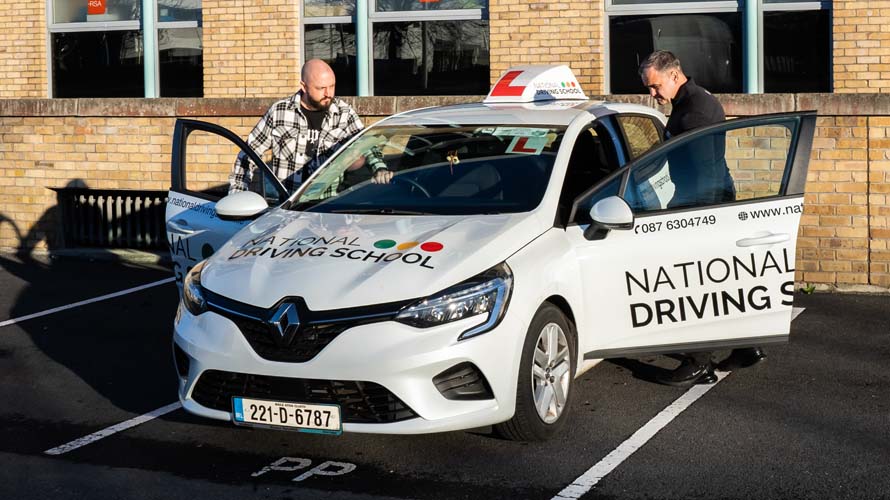
Why Choose National?
- Arrive on time, Everytime
- Pick-up & Drop-offs
- Clean & Modern Cars
- Flexible Booking Times
- Fully Qualified Instructors
Need Help?
If you need any help choosing lessons or general questions you can get in touch.
- 30 Years Experiance
- Male & Female Instructors